
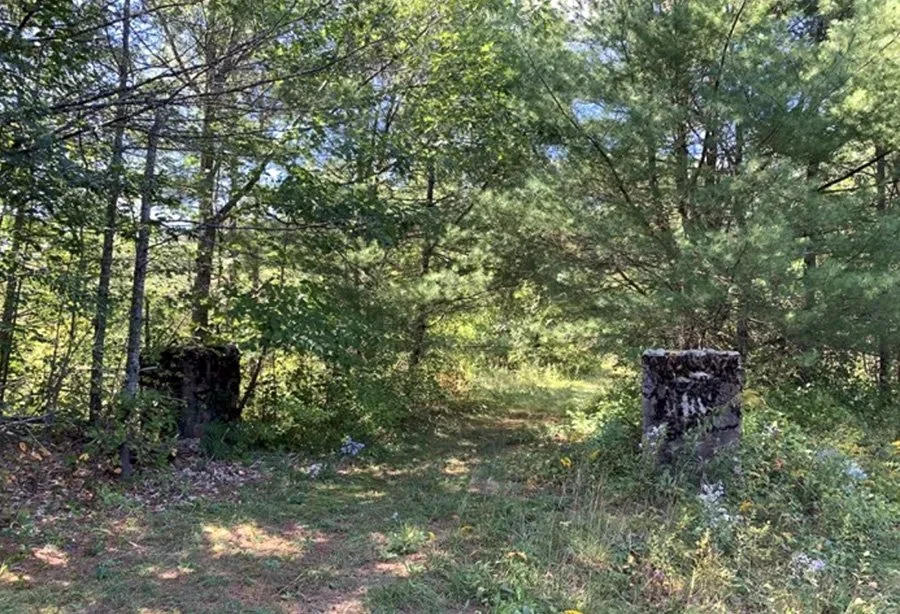
The entrance to what was the Golden Rule Farm in Old Hill Village.
By Kathi Caldwell-Hopper
Those who travel around the Lakes Region may not be aware that many years ago some communities were in existence but are long gone today.
In the late 19th and early 20th centuries, the unincorporated community of Livermore formed in the Grafton County, New Hampshire area. It started as a logging town, sitting between the Lakes Region and White Mountains.
In 1874, the Grafton County Lumber Co. was incorporated by the Saunders family. The Sawyer River Railroad was incorporated in 1876. By 1877, the railroad helped move logs for the Lumber Co.
In the 1880s, a smallpox epidemic raged through the village, and six residents died. That did not stop the population of Livermore from growing. It continued with lumber as the main job until the early 1950s, when Livermore was dissolved.
In the 1800s, rural Hill village was a community not far from the Newfound Lake area. The pretty little village was located between Bristol and Franklin (two larger communities).
Today, the original town of Hill is unpopulated, with fading roads and traces of cellar holes.
The former Hill Village was eventually moved to higher ground due to yearly flooding. The present-day town of Hill is still in existence. It is the place that those who once lived in the original community decided to relocate.
Hill was first settled on the banks of the Pemigewasset River and incorporated in 1778. Called New Chester, the town was part of 30,000 acres that included what are now the towns of Hill, Bristol, Bridgewater, and a portion of Wilmot and Danbury. The name of New Chester was changed in the late 1830s to Hill in honor of New Hampshire Governor Isaac Hill.
The current Hill Village, located on Route 3A between Bristol and Franklin, is a peaceful community. Contrary to what happens in most flooded areas, the village residents in the original Hill didn’t give up on their town and move to other communities after the 1930s floodwaters. Instead, they relocated the entire village to higher ground; this decision put Hill Village on the map as one of the first model communities in the United States.
(Old) Hill Village was once a lovely community by the banks of the Pemigewasset (Pemi) River. A train ran near the town, and small businesses thrived. The main street was the thoroughfare between Bristol and Franklin and lined with magnificent elm trees. Businesses included a chair factory, a dowel factory, and a railroad station, as well as stores carrying food and clothing.
Villagers attended one of two large churches, and children walked a short distance to the local school. There was a library and a town hall, and townspeople enjoyed community gatherings.
Homes were well built and some quite large, attesting to the success of area businessmen. Old photographs show sprawling homesteads, such as the John Huse house, built around 1800 with a huge barn connected to the large house, as pictured in The Story of Hill, New Hampshire by Dan Stiles.
A lesser-known fact about Old Hill Village is the Golden Rule Farm, established in 1871 as an offshoot of the New Hampshire Orphans Home. (The Home was originally part of the estate owned by Daniel Webster’s family and the place where the famous statesman was raised.)
The Orphans Home was established by Rev. Daniel Augustus Mack, who had been orphaned at age seven. According to an article titled “Golden Rule Farm Served as a State’s ‘Boys Town’ ” by Thomas P. Caldwell, the reverend was a chaplain during the Civil War, and he was often asked by injured or dying soldiers to look after their children. He took those requests seriously; thus, an orphanage was established, and its board of directors purchased the Webster farm.
Fast-forward to 1901, when Rev. George W. Buzzell was gifted the 100-acre Roberts Farm in Hill in 1901. Rev. Buzzell established a cottage-style housing arrangement for orphans and taught them life skills. In 1914, it was joined to the Golden Rule Homestead, which increased the size of the property to 400 acres, becoming the Golden Rule Farm.
Eventually, the Golden Rule Farm took in boys who needed discipline and a steady life. The boys, of all ages, were the product of hardship and were known at the time as “juvenile delinquents”. The Golden Rule used a caring approach when dealing with the boys.
Along with every building or business in Old Hill Village, the Golden Rule Farm had to relocate when the flood control Franklin Falls Dam was built in 1939. The Golden Rule moved onto property in Northfield.
After a false alarm of a flood, Frederick Clark, of the New Hampshire State Planning and Development Committee, visited Hill. He was aware the state wanted to buy Hill Village for a flood control project.
Clark thought the town could be relocated, but he was aware that Hill residents might meet the idea with resistance. The new dam would help the area during flood times, but it would mean the end of Hill Village, because each time the dam waters backed up, the town would be completely flooded.
Work began on a new Franklin dam in July 1939. Clearly, the old village was doomed. Residents knew they must relocate or face moving to other towns.
By June 1941, town offices and private homes were built in the new village, located on higher ground. Most people from the old village relocated to the new village. The old village was still standing, but already the abandoned buildings and homes had a ghost town feeling. It wasn't long before the government leveled all buildings. Nearly every spring, the cellar holes, sidewalks, and streets of the old village were flooded when rain swelled the Pemi River and Franklin Dam water backed up into the area.
On a lighter note, imagine a community on ice, with frozen Lake Winnipesaukee under your feet. You could warm up at one of many ice houses (known as a bob house) and socialize with fellow community members. The added enticement was fishing, a huge part of Wolfeboro Bay’s once-active Fisherville community.
What exactly was Fisherville and how did it make winter and ice fishing so memorable? According to The History of Wolfeboro, NH by Q. David Bowers/Wolfeboro Historical Society, Fisherville or Fisherville-on-the-Bay began in 1888. It was the name given to a group of bob houses made of wood and placed on Wolfeboro Bay. Ice fishing was popular at the time, whether for sport or out of the necessity to stock the pantry. It was cold on the open frozen lake, with winds that could sting and make ice fishing difficult. Thus, fishermen built structures to get out of the cold. The tiny structures were made of wood, and once inside, the fisherman could pull up a chair or stool and fish through the ice after cutting through the frozen water to create a fishing hole. Often, as the number of little ice fishing huts grew, fishermen would socialize and stop at a neighboring bob house to chat, to see how the fishing was going, and share a snack or mug of tea or coffee.
The ice community was named Fisherville, and as its popularity grew, the group of bob houses soon had “elected officials” with tongue-in-cheek rules and regulations. If you violated Fisherville’s laws, off to the Fisherville Municipal Court you went! The verdicts and sentences were all for fun, and at times, townspeople who were part of the ice community jokingly sat on the jury. If found guilty, you might end up in the Fisherville jail, where you had to endure a lot of teasing from fellow fishermen.
As the years passed, locals and visitors looked forward to the re-emergence of Fisherville when bob houses were hauled onto frozen Wolfeboro. Fisherville residents socialized and cooked on campfires on the ice. Even if you weren’t an ice fisherman, you could walk out onto Wolfeboro Bay and visit with friends who were fishing. The socialization aspect of the community made it very popular, and stories in local newspapers offered “fictionalized” and fun accounts of life at Fisherville.
Fisherville reached its height of popularity in the winters of the 1930s to early 1940s, and it is no wonder why. With World War II causing worry and the recent Great Depression, people needed something fun to take their minds off their troubles. Fisherville filled that need.
Such was the popularity of the ice community that streets were laid out on the ice, districts were created, and officials were “elected”. The community town hall, jail, and courthouse were all for fun.
In the 1950s, Fisherville remained popular, according to The History of Wolfeboro, NH by Q. David Bowers. The bob houses were placed on the ice, and everyone continued to enjoy the community, but nothing could rival the World War II era for the fun of Fisherville.
The ice community helped people get through the long winters and war years, offering socialization, a lot of humor and fun, as well as a nod to the sport of ice fishing.