
By Alyson Short
For most of her life, local author Helen Fernald's model for dealing with grief was simple: keep moving.
When her father died while Helen was in her twenties, she watched her mother power through. She stayed busy, stayed strong, and kept going. It was reassuring, in its way, giving young Helen the comforting, almost childlike belief that her mother would live forever.
So when an urgent telegram arrived years later while Helen was vacationing in Spain with her husband and young daughter, the shock was total.
Her mother had died suddenly, of a massive heart attack.
Helen dropped everything and returned to New York, then on to Cleveland to help her brother deal with the logistics that a sudden death leaves behind. There were arrangements to make, a life to sort through, and a young family waiting for her. There was no room left to feel what had happened, and Helen followed the only model of grief she knew – her mother, who had simply kept moving.
So Helen went back to teaching. She stayed busy with her young family. When her second child was born, the demands of a newborn gave her another perfectly legitimate reason to keep pushing grief down. At some level, Helen had absorbed a warning: don’t cry, because if you do, you won’t stop. She tried to stay joyful and grateful.
But, as she would eventually realize, it was "false joy and false gratitude."
Buried grief doesn’t stay buried quietly. Helen struggled with her health in various ways until five years after her mother’s death, she landed in the hospital with a fractured back. A friend visited her in the hospital and gently pointed out that, in a spiritual sense, the spine represents our support system—and Helen had broken the vertebra directly behind her heart. Having to lie still for the first time in years forced Helen to consider the grief she hadn’t allowed herself to feel. She accepted that she had more than a broken back to mend.
She found excellent counselors who helped her get a start but still felt that something was missing.
Then came a series of experiences Helen describes as unexpected guidance. While recovering, her family stopped at a bookstore in Portsmouth. Helen, then mid-forties, wandered toward the self-help section without really knowing what she was looking for. She stood there a while, not knowing where to look, when a book fell from the shelf and landed at her feet. The book was about angels.
It was her first real brush with the possibility that there might be more to life than what we can see and touch.
Not long afterward, another nudge arrived in an email from her daughter, who was living in California. She sent Helen information about an online writing workshop taught by self-help author Gay Hendricks.
Helen had never taken an online class. She had never wanted to write a book. She signed up anyway.
"I had no idea what I would write a book about!" she remembers.
Still wondering what she could possibly write, Helen went into a quiet room in her Wolfeboro home that she used for meditation, and throwing her hands up, asked the question out loud: “What am I going to write a book about?”
The answer came immediately: I will write letters to my mother.
"It was such an obvious answer, just so clear," Helen says. It was only surprising because she hadn't thought of it sooner. Helen had grown up in a family where letters were part of everyday life. She and her brother wrote back and forth for 50 years, using letters to stay connected and share what was happening in their lives. She had also maintained relationships through letters with a Spanish host family from her teenage exchange-student years and with her aunt Helen, her namesake, until her aunt's death at 101.
So Helen sat down and wrote to her mother. Not about her mother, to her mother. This wasn’t journaling; Helen wrote directly to her mother, sharing the things a daughter might tell her mother: ordinary details, vulnerable truths, difficult feelings, family happenings. A journal might have given her a place to record those thoughts, but a letter gave them a recipient. She wasn't simply documenting her grief; she was continuing a relationship.
And then the tears came. "I wrote and wrote and wrote, and sobbed and sobbed and sobbed," she says. "And when it was over, I felt so much better."
More letters followed, sometimes prompted by an urge in the middle of the night. "Writing, writing, writing, and sobbing, sobbing, sobbing."
Every letter ended the same way: "Love, Helen." And after every letter, Helen felt better. “It was such a powerful way to express my feelings,” shared Helen, and she recognized that something remarkable was happening.
Helen discovered that in burying her grief, she had also buried her memories. As she allowed herself to feel what she had spent years avoiding, beautiful memories began returning. Instead of bringing only sadness, they brought joy.
The letters also changed the way she saw her mother.
When we lose a parent, Helen says, part of us can remain caught in the perspective of childhood. Her mother had been a phenomenal woman, but Helen had also carried resentments that belonged to the complicated relationship between a daughter and her mother.
Writing allowed her to see her mother as a whole person. The memories brought new perspective and understanding. The resentment began to dissolve. The joy and gratitude she had tried to manufacture before became something real.
"I learned that grief is not something to be afraid of; it is not our great enemy," Helen says. "We need to honor our grief. Grief is our great mentor."
She came to understand that regardless of society’s messaging, we are not supposed to "get over" grief. We acknowledge it, honor it, and move through it. In doing so, we can develop a new relationship with the person we've lost.
Helen's own life continued to provide reminders of that connection. Her brother died in August 2020, after decades of writing letters back and forth. Three days after his death, a letter from him arrived in Helen's mailbox. He had written it before he died, of course, but it arrived afterward, carrying news of his life and the ordinary things they had always shared.
"We're connected," Helen remembers thinking.
She still feels that connection with her mother. Her mother loved Monet, and when Helen sees the water lilies at the Cleveland Museum of Art, she remembers her with happiness. Poppies, her mother's favorite flowers, do the same.
Eventually, Helen knew the letters would become a book. She just didn't know when the writing would end. Then, one Mother's Day, she remembered—as she always did—that she needed to write her mother a letter.
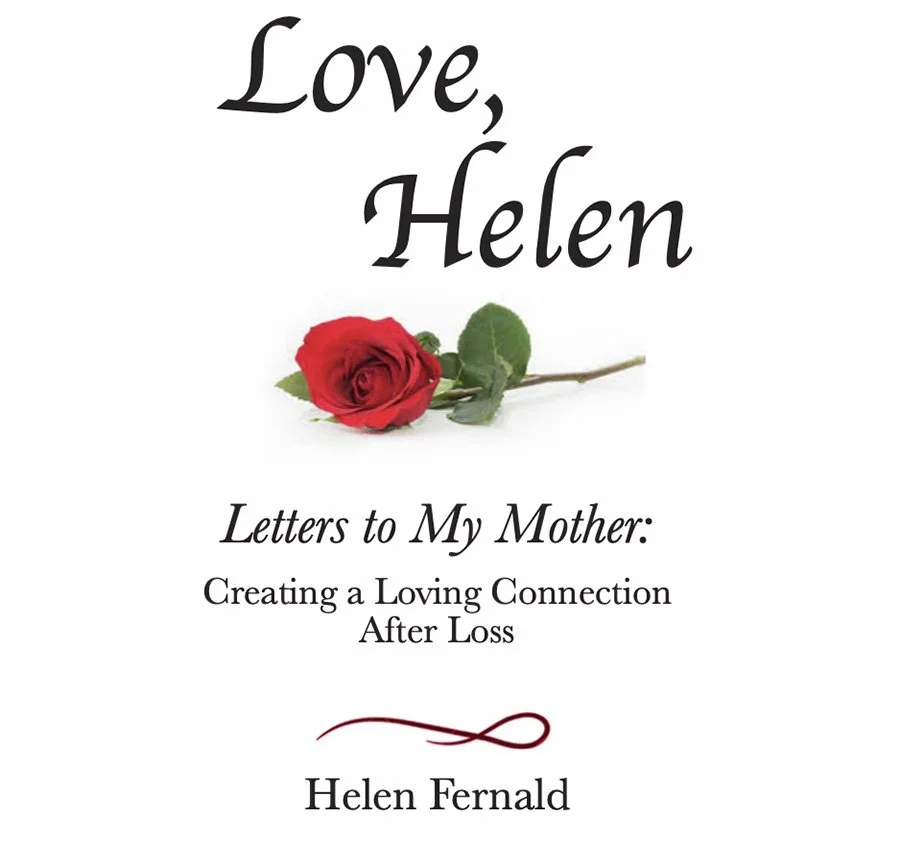
"Well, I have to write a letter to my mother!" She picked up the pen and pad she kept nearby and began. When she reached the end, the letter ended differently from all the ones before it. Helen knew it was the last. The letters became her book, Love, Helen.
What began as a deeply personal way of processing grief eventually became something Helen wanted to share—not because everyone needs to publish their letters, but because nobody needs to. In fact, she wants people to understand that the privacy is part of the point. Nobody needs to see the letters you write.
"You just have to give yourself permission to be honest, open, and vulnerable on the page," she says. "It is extraordinarily healing."
Helen has since learned that there is scientific research into the psychological and emotional benefits of handwriting, reinforcing something she had discovered for herself. In a world where children increasingly type rather than write by hand and are no longer learning cursive, she worries that something valuable is disappearing.
Letter writing can preserve relationships across distance. It can hold memories. It can give emotions somewhere to go. And it can create a conversation with someone who is no longer here. "Anything I can do to encourage letter writing, I will do," Helen says.
This November, Helen will put that belief into practice with a free letter-writing class at the Wolfeboro Public Library (259 South Main Street, Wolfeboro), 11 am, on Friday, November 6. She'll even provide the stationery. Participants only need to show up.
The class will focus on writing to people we've lost, but Helen's message reaches beyond grief. We live in a world filled with ways to communicate instantly, yet many of us have lost the quiet, private practice of putting pen to paper and saying what we really mean. Consider writing a letter to someone you’ve lost. Then consider writing to someone who is still here – and keep writing.
Connecting through letter writing doesn’t have to wait until someone is gone. Tell them what happened this week. Tell them what you miss about them, tell them what made you laugh. Tell them what you wish you could say in person.
A handwritten letter asks us to slow down, to remember, to feel. Helen’s experience is proof that the simple act of letter writing can be a powerful passage through grief. We don't get over grief, Helen believes. We acknowledge it, honor it, and move through it. And somewhere along the way, we can discover that although the person is gone, the relationship isn't.
To learn more about Helen Fernald and her book, Love, Helen, visit HelenFernald.com. The book is also available on Amazon or, preferably, you can buy it locally at The Country Bookseller in Wolfeboro (23-A North Main Street). Readers are also invited to join Helen’s workshop at 11 am on Friday, November 6, at the Wolfeboro Public Library – just bring yourself and Helen will provide the rest.