
By Thomas P. Caldwell
Jim Salge of Yankee Magazine is predicting that the 2026 fall foliage display will be substantially better than last year, when drought and diseased trees dampened the colors and shortened the season. This past winter was a classic New England one, with cold temperatures sealing moisture in the soil, followed by a springtime snowmelt that nourished the trees. Unlike some years, the trees did not divert energy into the overproduction of seeds, allowing them to leaf out in abundance.
“New England’s healthy, full canopies mean that the overall palette should be bright,” Salge wrote. “Time will tell how well the trees reveal their underlying colors, but if we get those ideal warm, sunny days followed by crisp, cool nights as the leaves begin to change, we could be in for some fiery reds.”
Salge also predicts that the foliage season will see a gradual color change, unlike last year when the season was quickly over. Some trees already are showing fall colors in September, but he believes there will be a slower progression across the landscape. “We should have plenty of time as color slips its way south, from the northern mountains to the southern coast,” he wrote.
This year, the El Niño weather pattern returns, meaning that this autumn is likely to be warmer than normal, but there should still be some crisp, cool nights to bring out the fall colors.
Typically, the foliage season begins in late September, peaking between October 5 and 16. The colors then remain through the end of October.
The NH Tourism Board advises that peak foliage in New Hampshire’s Great North Woods already is at hand and expected to last until October 5. The White Mountains should peak between October 5 and 10, with the foliage season in the Dartmouth-Lake Sunapee Region running October 5 - 15. In the Lakes and Monadnock regions, foliage should reach its peak between October 10 and 20, while Merrimack Valley is projected for peak foliage between October 20 and 25. For the Seacoast, it will be October 20 - 31.
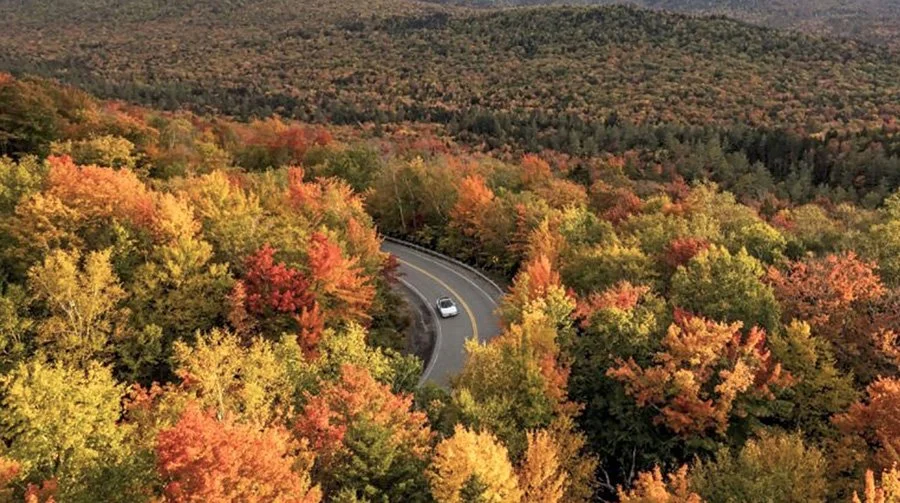
The popular consensus is that the best viewing is in New Hampshire’s White Mountains and, specifically, along the Kancamagus Highway between Lincoln and Conway. However, there are plenty of less-traveled roads that also provide some spectacular leaf-peeping.
One of those areas is around Lake Winnipesaukee, with the corridors also offering short hikes and the lake providing the setting for foliage cruises. The colors around the Big Lake are just as brilliant, but they appear a little later than in the north and the higher elevations.
For those heading north, Littleton is situated in the midst of the foliage belt, and the town boasts a covered bridge across the Ammonoosuc River that offers a view of riverbanks lined with fall colors — and a riverfront walking trail provides another way to observe those colors.
In the Conway area, October provides beautiful foliage around the Saco River and Swift River covered bridges.
Artist’s Bluff over Echo Lake in Franconia is just a short uphill hike (about a half-mile) from the Cannon Mountain parking lot. The trail is well-marked but has some steep and rocky sections. It is best to go early, as it can get crowded during peak foliage season, especially on weekends. Even if you don’t make the climb, Echo Lake offers a photogenic setting, with calm water that, on a still day, provides great reflections of the fall colors on the surrounding mountains. It also has a small beach area and a walking path.
If you want to avoid those areas where the crowds of leaf-peepers gather, head over to Sugar Hill, just west of Franconia. With open fields and mountain views, it is a peaceful place to pause and enjoy the fall foliage.
Haverhill, on the Connecticut River in western New Hampshire, also offers a chance to see the foliage without the crowds that frequent the more popular locations. Haverhill is home to the Bedell Bridge State Park and the 1829 Haverhill-Bath Covered Bridge. The colors along the Connecticut River can rival any that one finds in the White Mountains.
Then there is Tamworth, actually comprising five villages with historic buildings and quaint shops and cafés. Being surrounded by the White Mountain National Forest, Hemenway State Forest, and White Lake State Park and close to the Lakes Region, there are ample opportunities for leaf-peeping, including from the Great Hill Fire Tower.
Chocorua Lake is peaceful, with limited development, and it offers great views of Mount Chocorua, which is especially beautiful when the foliage peaks.
Way up north is Pittsburg, bordering Canada and possessing serene lakes and vast forests. There one can visit Lake Francis State Park, one of the least-crowded state parks in New Hampshire, and a great place to view the fall foliage.
At the other end of the state is the Madame Sherri Forest, located in the southwestern corner of New Hampshire. Best known for its ruins of a house built by Madame Antoinette Sherri, a costume designer from New York, the forest has trails such as the Ann Stokes Loop, an easy-to-moderate path through the woods that passes a small pond and can offer some beautiful fall colors later in the season.
Still, the White Mountains call for attention during foliage season. Over at Pinkham Notch, one can drive the Mount Washington Auto Road, or take the Cog Railway from Route 302, to take in the panoramic landscape from the summit (if it’s a clear day — not always the case on the mountain with the “World’s Worst Weather”) where the fall colors in the valleys contrast with what, even during the fall, can be a snowy peak.
Jackson boasts the Historic Honeymoon Covered Bridge, sitting in the midst of the colorful fall displays; and nearby is the Historic Bartlett Covered Bridge, dating from 1851 but no longer able to accommodate cars.
Reflection Pond in Gorham can act as a mirror of the surrounding trees and mountains, making it a beautiful spot to admire the colorful fall foliage.
Truthfully, almost any remote route can take the traveler past some spectacular fall foliage and reveal hidden gems that will thrill photographers and provide a place to sit back and admire what Mother Nature can provide.